Child Actor 101
Child Actor 101
Real talk for acting parents
How to Memorize Lines  ·  A Field Guide for Parents
The Memorization Guide · Part of the Self-Tape System

How to Memorize Lines Fast.
Without the Burnout.

Any kid can memorize several pages of sides in 15 to 30 minutes — without tricks, hacks, or tears. The secret? Stop memorizing like it's a spelling test.
Here's the part nobody tells you Most parents use stage-play memorization techniques for auditions — but auditions aren't plays. A self-tape is here and gone. A scene on set is shot and over. It's all short-term. The techniques you were taught don't match the medium.
The Old Way
Memorization is repetition.
The Shift
Memorization is understanding.
The Mental Shift
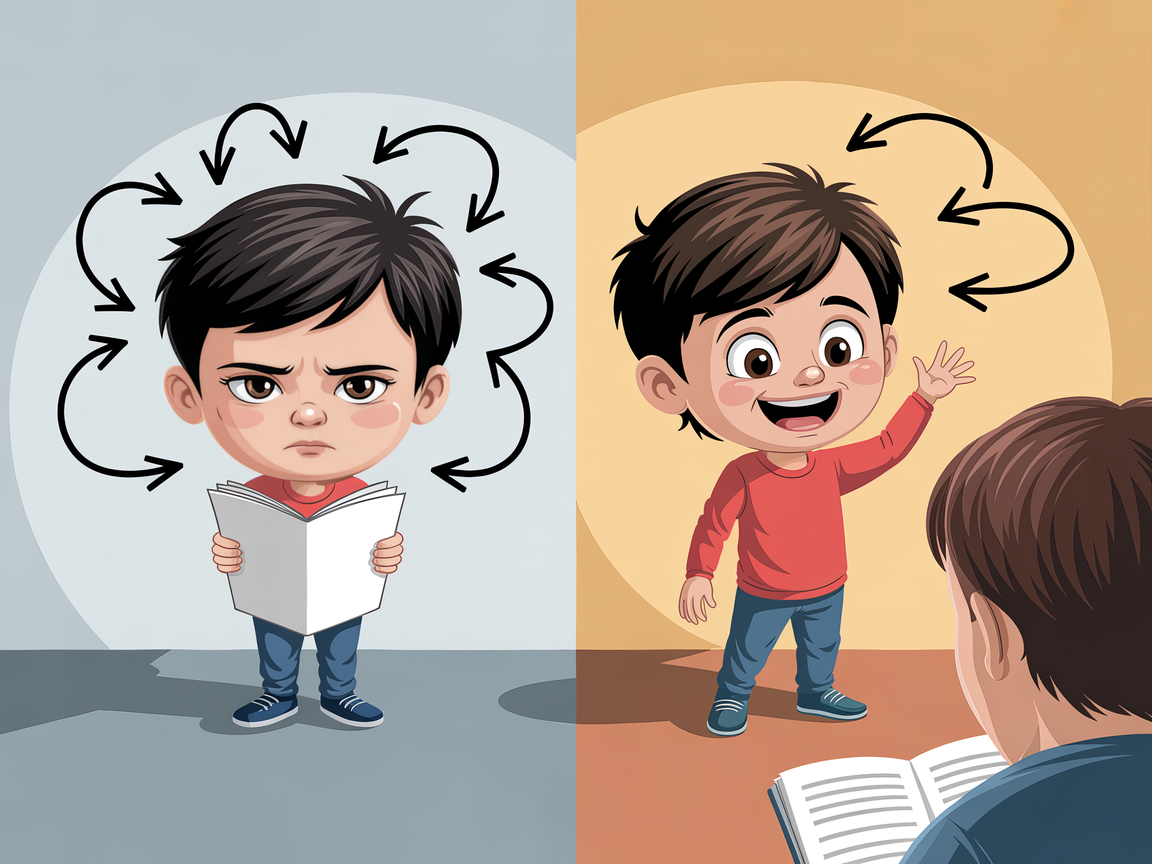
The mental shift: from drilling words to living the scene
On the left — a kid drowning in words. On the right — a kid in the scene. Same script. Totally different outcome.
What's Inside · The Five-Step Method
01Read Out Loud
02Understand First
03Skip Word-for-Word
04Play the Scene
05Stay Fresh
The five-year-old who broke the method.

Years ago I was coaching a five-year-old before an agency meeting. Short script. No time. Here's the catch: he couldn't read yet.

So I did the only thing I could. I explained the scene. I told him what his character wanted. I said my line, and then I told him what his character would say back. We ran it through three times like that — call and response, meaning first, words second. Then I asked him to run it with no hints.

He nailed it in fifteen minutes. Not just memorized — performed. In the moment. Listening. Responding like a real person.

He didn't memorize the words. He memorized the story. That's the whole method.
01
Read it out loud. Three to five times.
Non-Negotiable

The first pass isn't about memorizing. It's about hearing the scene.

Most kids read the script silently, in their head. That does almost nothing for an actor. Reading out loud does three things at once:

  • Builds the rhythm of the scene
  • Connects voice to memory
  • Locks in the story, not just the words
  • Silent reading won't cut it
If your kid is reading quietly on their bed — gently redirect. Out loud, or it doesn't count.
02
Understand before you memorize.
The Foundation

The brain doesn't remember random sentences. It remembers meaning.

Before your kid tries to lock in a single word, they need to answer three questions. Every time.

  • What's happening in this scene?
  • What does my character want?
  • Who am I talking to, and what's my relationship to them?
Lines stick when the story makes sense.
Consider the master
Meryl Streep reads a film script five times and she's memorized. She doesn't drill. She takes in the story deeply, lives the scene in her head, figures out the character — and the words just click. That's not a superpower. That's content memorization.
Stuck here? This is where most actors freeze — they understand the scene but can't see a bold, specific choice to play. Try Bold Choices →
03
Don't memorize word-for-word yet.
The Counterintuitive One

This is where most kids get stuck — and where most parents accidentally make it worse.

Drilling for exact wording on the first pass creates stiff, robotic performances. Instead, on the early passes, let your kid:

  • Say what makes sense in the moment
  • Follow the logic of the scene
  • Trust their instincts on phrasing
  • Don't chase "perfect" wording yet
Here's the magic: they'll almost always be close. And once they understand the scene, the brain corrects the rest on its own. Unless Aaron Sorkin is in the room, substituting a word here or there is usually forgivable — as long as the content and intention stay intact.
04
Play the scene. Don't drill it.
Make-or-Break

Run the scene 5 to 10 times — but with a reader, and with variety.

This is the single biggest shift between actors who perform and actors who recite. Every run-through should feel a little different.

  • Always with a real reader, not self-read
  • Try different intentions each time
  • Experiment with different energy
  • Stay curious, not mechanical
Playing the scene builds memory and performance — at the same time.
Need structure? If you want this process broken down for your kid's actual sides — scene objective, character breakdown, beat-by-beat — Prep101 does it in minutes →
05
Stay fresh. Never say it the same way twice.
Avoid Stiffness

Once a line feels "locked in" a certain way, it dies.

The whole point of memorization is to free the actor — not to trap them. Keep the scene alive by:

  • Exploring different choices
  • Staying flexible
  • Keeping the scene alive
  • No robotic repetition
Repetition creates stiffness. Variety creates skill.
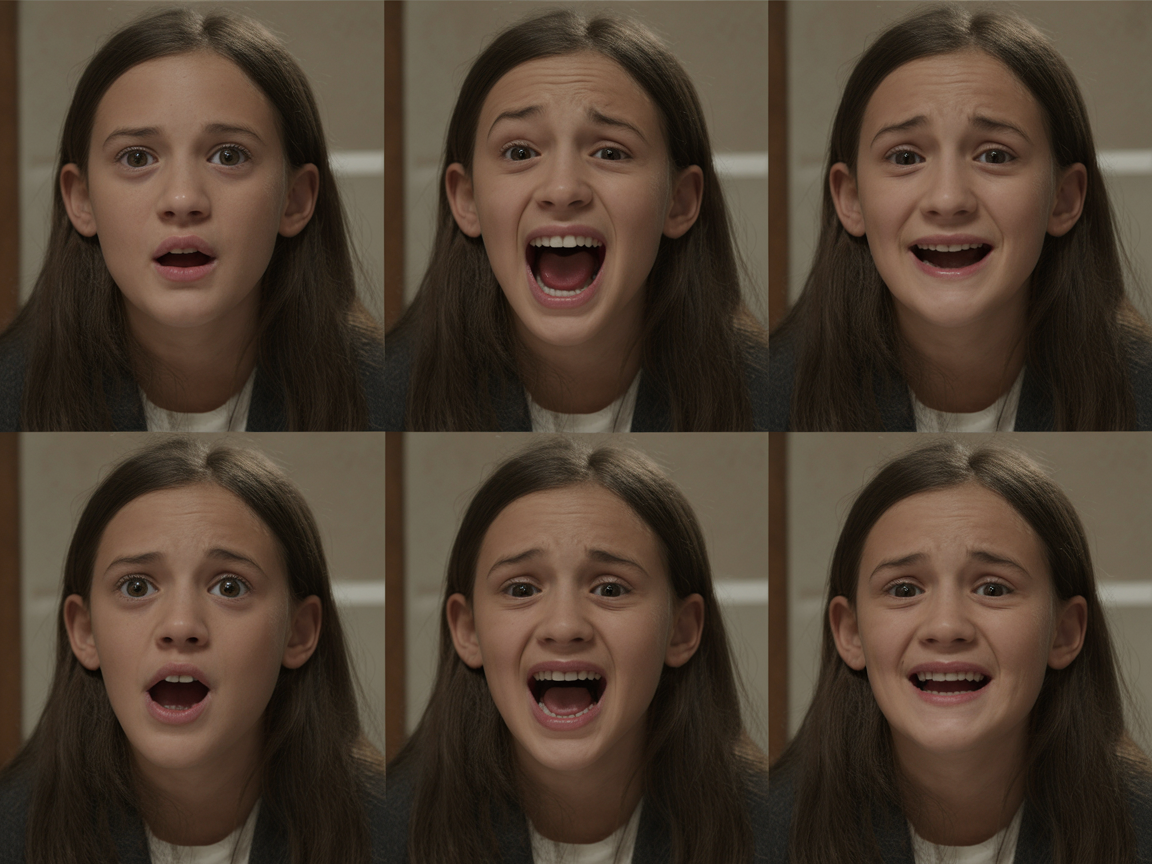
Same line, different emotional deliveries
Same Line · Six Different Deliveries
One sentence. Surprised, angry, scared, curious, heartbroken, defiant. The words don't change — the acting does. That's what "stay fresh" looks like in practice.
Here's what nobody explains: memorization techniques for stage plays are different than for TV and film. A play runs for weeks — that needs muscle memory. A self-tape is here and gone. Most parents are using the wrong toolkit entirely.

Think like a five-year-old. Get out of the hysteria over the words and into the scene itself. Content memorization cements the story — which frees the actor to breathe fresh air into every line.
— The Corey Ralston take
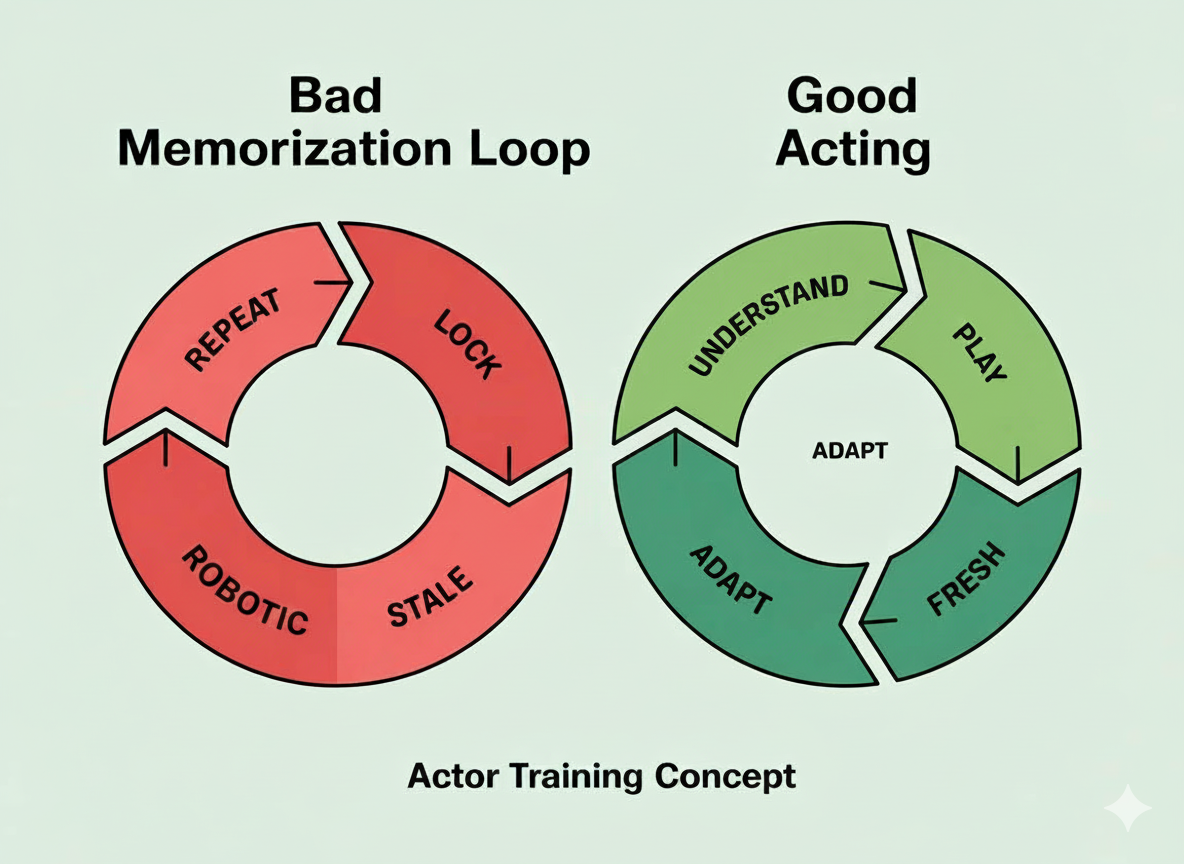
The Two Loops
Bad Memorization Loop vs Good Acting Loop
The bad loop dies on itself: Repeat → Lock → Stale → Robotic. The good loop stays alive: Understand → Play → Fresh → Adapt. Same five minutes of rehearsal. Completely different tape.
For Parents
How to help — without making it worse.
Read This Twice

This is where most parents accidentally derail the whole thing. Not out of malice — out of love. You want them to nail it, so you drill. And drilling is exactly what kills it.
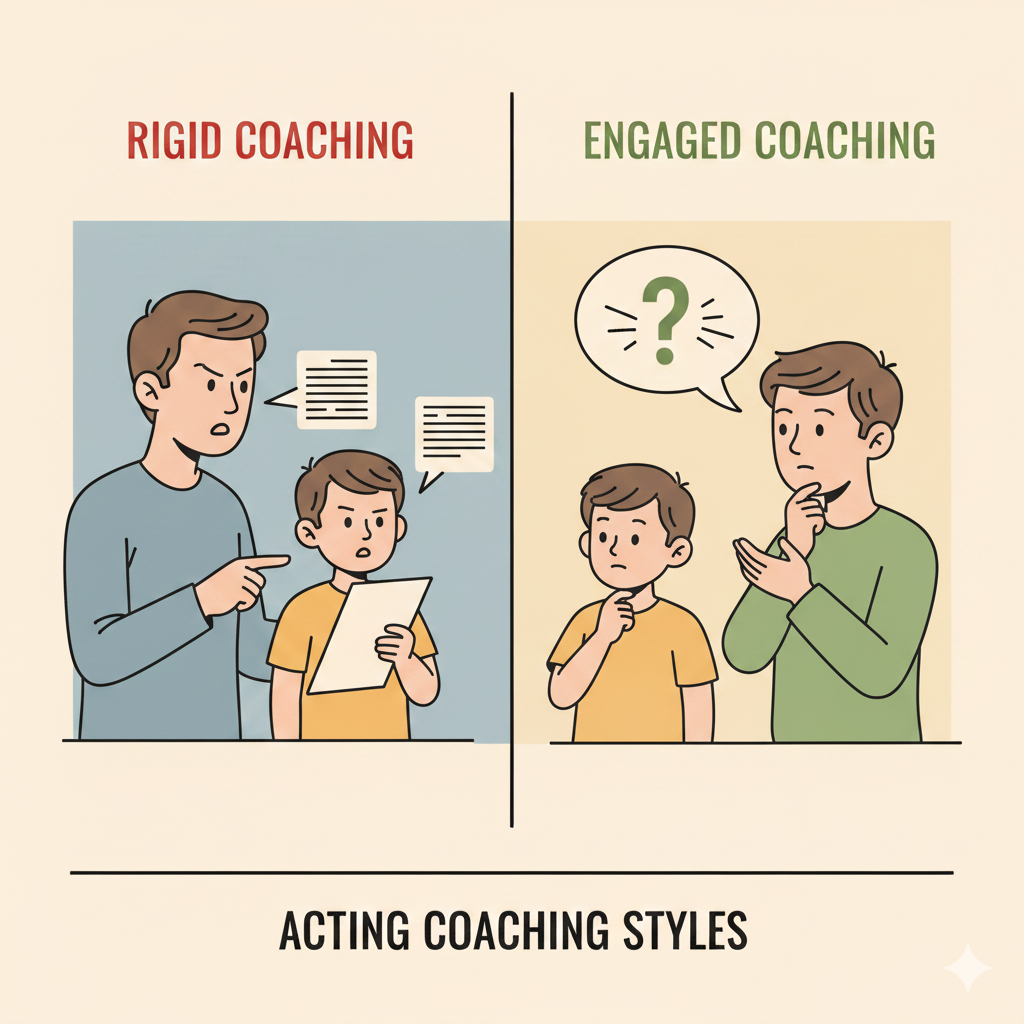
Rigid coaching vs engaged coaching
The difference between a stressed-out kid and a thinking kid lives entirely in how the parent asks the question.
Don't
  • Drill lines like a quiz
  • Correct every word immediately
  • Panic when they forget
  • Rush them to "get it right"
Do
  • Ask: "What happens next?"
  • Let them say it in their own words first
  • Guide them back to accuracy naturally
  • Stay calm when they stumble
You're not a line coach. You're building understanding.
When It's Bigger If your child freezes on lines and it's become an emotional pattern — that's not a memorization problem anymore. Book a coaching session →
Common Memorization Mistakes

The six things that silently sabotage memorization.

Most of these feel productive in the moment — which is why they're so easy to fall into. If you catch any of these happening, stop. Reset.
Stop Doing This
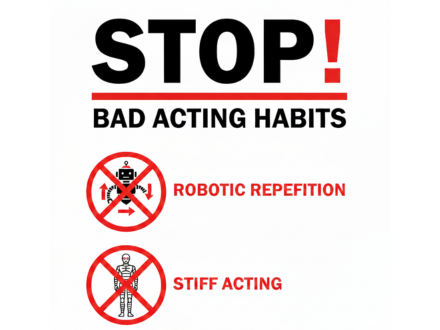
Stop bad acting habits: robotic repetition and stiff acting
Two habits casting spots in the first ten seconds: robotic repetition and stiff acting. Both come from the same root cause — drilling words instead of understanding the scene.
Mistake 01
Silent reading.
Reading the script in their head. Looks like studying. Does nothing for an actor.
The Fix
Out loud. Always.
Mistake 02
Line-by-line drilling.
Breaking the scene into single lines and repeating each one. Creates mechanical, disconnected delivery.
The Fix
Work in scenes, not sentences.
Mistake 03
Chasing "perfect" too early.
Obsessing over exact wording on the first pass. Locks your kid into stiffness before they even understand the scene.
The Fix
Understand first, polish later.
Mistake 04
Editing fed lines together.
Feeding the kid each line off-camera, then editing the takes together so it "looks" memorized. Casting spots it instantly. It's cheating. They hate it.
The Fix
No shortcuts. Memorize for real.
Mistake 05
The audio loop.
Recording the lines and playing them on repeat, hoping they stick like a song. They don't. You get a kid who can recite — not an actor who can perform.
The Fix
Learn the scene, not the sounds.
Mistake 06
Self-reading.
No real scene partner. No rhythm. No listening. Memorization without a reader is just recitation.
The Fix
Always with a real reader.
Once It's Memorized, Then What?

Memorizing is step one.
The performance is step two.

Knowing the lines isn't booking the role. Most kids still don't know what choices to make, how to build the performance, or how to make it land on tape. That's where the system comes in.

Step 01
Bold Choices
Get unstuck fast
The version of the scene that actually books. Not the safe one. Not the obvious one.
Step 02
Prep101
Build the performance
Upload the sides, get a full breakdown. Walk into the room actually prepared.
Step 03
Coaching
The guided version
Three decades of casting-room experience, one session at a time. When the stakes are real.
Lines memorized is the floor. A performance casting remembers is the ceiling.
Your Next Audition

Memorized the lines. Now what?

The words are the easy part. The performance — what choices to make, how to stay alive on camera — is where most kids get lost. Start with a custom breakdown of the actual sides.

This guide fixes the memorization. This is what fixes the performance.